
The pressure to justify every pound of digital marketing spend has never been greater for SaaS founders. Boards want numbers. Investors want growth. And your team wants a clear direction. Yet most SaaS companies still operate without a coherent, data-driven plan, running disconnected tactics and hoping something sticks. Organic search generates 44.6% of B2B SaaS revenue, and SEO delivers a 702% ROI with break-even in just seven months. That is not a coincidence. It is what happens when strategy replaces guesswork. This guide breaks down exactly how to build a digital marketing plan that drives measurable, sustainable growth for your SaaS business.
Table of Contents
- Define your goals and ideal customer profile (ICP)
- Audit your current digital marketing performance
- Choose channels and tactics that deliver sustainable ROI
- Set KPIs and allocate budget based on data
- Build your digital marketing plan: step-by-step framework
- Measure, optimise, and adapt: keep your SaaS marketing plan agile
- Partner with experts for SaaS marketing success
- Frequently asked questions
Key Takeaways
| Point | Details |
|---|---|
| Focus on retention | SaaS brands with higher retention and NRR achieve greater ROI and sustainable growth. |
| Leverage SEO and content | SEO and content marketing deliver industry-leading ROI and fastest break-even for SaaS. |
| Benchmark your metrics | Regularly compare funnel performance to SaaS benchmarks to spot gaps and priorities. |
| Invest in agility | Agile marketing plans allow you to test, learn, and optimise swiftly as your SaaS business evolves. |
Define your goals and ideal customer profile (ICP)
To get results you can measure, you first need to know exactly whom you want to reach and what outcomes matter most. Without this foundation, every channel decision and budget allocation becomes a gamble.
Start by clarifying your core business goals. Are you focused on growing annual recurring revenue (ARR), expanding your user base, reducing churn, or driving expansion revenue from existing accounts? Each goal demands a different marketing approach. Vague ambitions produce vague results.
Next, build a fact-based ideal customer profile. Segment your audience by revenue potential, churn risk, and product fit. A data-driven ICP aligned to the full customer journey, from acquisition through to expansion, is the single most reliable driver of sustainable SaaS growth. Your ICP should inform every piece of content, every ad, and every email you send.
Here is what a strong ICP framework covers:
- Company size and sector: Where does your product create the most value?
- Decision-maker profile: Who signs off on the purchase?
- Pain points: What problem are they actively trying to solve?
- Buying triggers: What prompts them to look for a solution like yours?
- Churn indicators: Which customer types are most likely to leave?
Retention is the most underrated growth lever in SaaS. Acquiring a new customer costs five times more than retaining one. Build your plan around keeping customers, not just winning them.
Understanding ROI in SaaS marketing starts with knowing which customers generate the most long-term value. Pair that with strong digital branding for SaaS growth and you create a compounding advantage that paid ads simply cannot replicate.
Audit your current digital marketing performance
With goals and audiences set, it is essential to understand where your digital marketing stands before you plan your next moves. An honest audit removes assumptions and replaces them with facts.
Collect data across every active channel. Focus on:
- Acquisition sources: Where is your traffic actually coming from?
- Customer acquisition cost (CAC): What does it cost to win each new customer?
- Lifetime value (LTV): How much revenue does each customer generate over time?
- Conversion rates: Where are prospects dropping out of your funnel?
Compare your numbers against industry benchmarks. B2B SaaS sites convert 2.3% of visitors to leads, opt-out trials achieve 49 to 60% conversion, and the median net revenue retention (NRR) sits at 101%. If your numbers fall short, you have found your priorities.

The median CAC for SaaS is $2 spent per $1 of new ARR, with SEO-driven CAC ranging from $480 to $942 per customer. That sounds high until you compare it to paid acquisition, which often costs three to five times more with no compounding benefit.
| Channel | Typical CAC | Time to ROI | Sustainability |
|---|---|---|---|
| SEO and content | $480 to $942 | 7 months | Very high |
| Paid search | $1,200 to $3,000+ | Immediate | Low (stops when spend stops) |
| Email marketing | $200 to $500 | 1 to 3 months | High |
| Social media (organic) | $300 to $800 | 3 to 6 months | Medium |
Review your customer journey data strategies to identify where prospects stall. Then examine your SaaS website conversion rates to understand whether your site is helping or hindering growth.
Choose channels and tactics that deliver sustainable ROI
After assessing your performance gaps, choose channels that will move the needle, backed by data. Not every channel deserves your attention. Focus is a competitive advantage.
SEO and content marketing deliver 702% ROI and account for 44.6% of B2B SaaS revenue. That is why the highest-performing SaaS businesses invest in content first. It builds authority, generates compounding traffic, and attracts the right buyers without paying for every click.
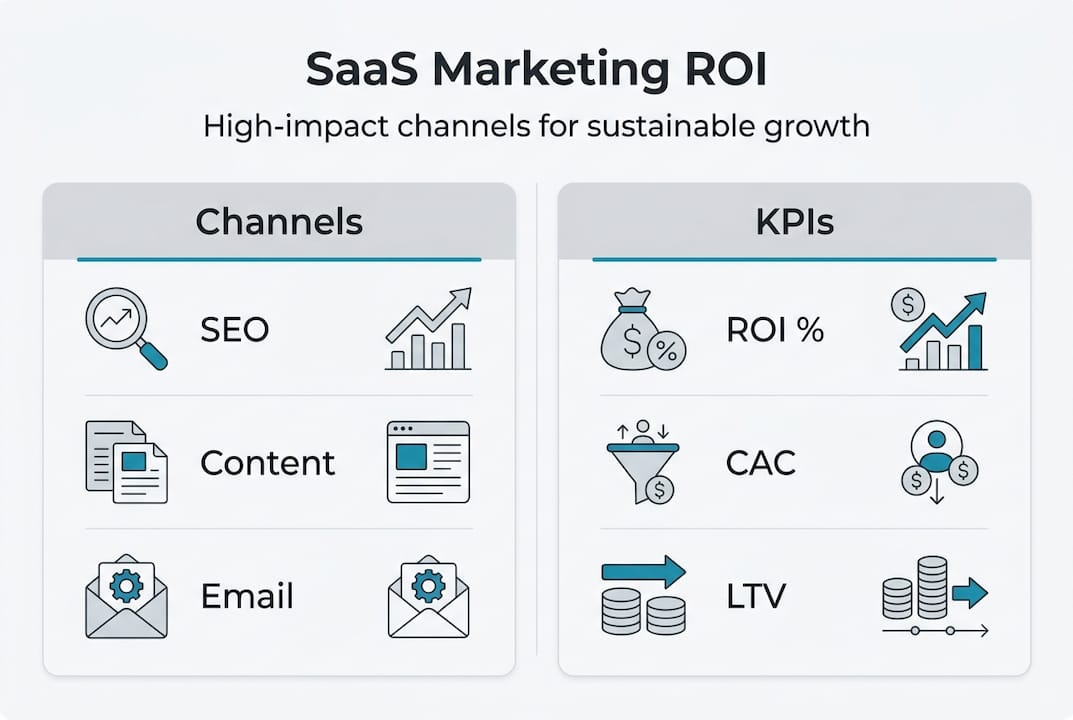
Email marketing remains one of the most cost-effective channels for nurturing leads and driving expansion revenue. 64% of SaaS marketers are now integrating AI into their workflows, but the core channels, SEO and email, still dominate for measurable ROI. AI tools accelerate production and personalisation. They do not replace strategic thinking.
Here is how the main channels compare:
| Channel | CAC payback | LTV:CAC potential | Best for |
|---|---|---|---|
| SEO and content | 7 to 12 months | Very high | Long-term authority and inbound |
| Paid search | 1 to 3 months | Medium | Fast testing and demand capture |
| Email marketing | 1 to 2 months | High | Nurture, retention, expansion |
| Social media (paid) | 2 to 4 months | Medium | Brand awareness and retargeting |
| AI-driven campaigns | Varies | High (with optimisation) | Personalisation at scale |
For content marketing for SaaS, prioritise topics your ICP is actively searching for. Build a digital marketing workflow that connects content creation to distribution and measurement. You can also explore cost-effective SaaS marketing strategies to stretch your budget further.
Pro Tip: Avoid channel overload. Pick two or three channels your ICP actually uses and do them exceptionally well. Spreading budget across six channels produces mediocre results across all of them.
Set KPIs and allocate budget based on data
Once you know which channels to prioritise, it is time to set, track, and fund your campaign priorities intelligently. Budget without KPIs is just spending. KPIs without budget are just wishes.
Here is a step-by-step process for setting KPIs and allocating spend:
- Define your target ARR growth for the next 12 months.
- Calculate how many new customers you need to hit that target.
- Estimate CAC per channel based on your audit data and industry benchmarks.
- Set your LTV:CAC target at a minimum of 3:1. Anything below signals an unsustainable model.
- Allocate budget to channels with the lowest CAC and fastest payback period first.
- Set CAC payback targets at under 12 months. The median SaaS CAC is $2 per $1 of new ARR, so model your spend accordingly.
- Review KPIs monthly. Adjust allocation based on what the data tells you, not what feels right.
The KPIs that matter most are CAC, LTV, conversion rate at each funnel stage, and payback period. Track them consistently. Vanity metrics like impressions and follower counts tell you nothing about revenue.
Pro Tip: Work backwards from your business targets. Your budget should follow your goals, not the other way around. If you need 50 new enterprise customers and your SEO CAC is $800, you know exactly what to invest.
Explore lifecycle marketing in SaaS to understand how budget allocation shifts across the customer journey. And if conversion is a bottleneck, focus on boosting SaaS conversions before scaling spend.
Build your digital marketing plan: step-by-step framework
With strategy and budget defined, this section turns insight into action. A plan without a clear sequence is just a list of good intentions.
Follow this ordered framework:
- Audience research: Validate your ICP with real customer interviews and CRM data.
- Messaging: Define your core value proposition for each segment. Be specific about the problem you solve.
- Content planning: Map content to each stage of the buyer journey. Top of funnel builds awareness. Middle of funnel builds trust. Bottom of funnel drives decisions.
- Channel activation: Launch your two or three priority channels with clear ownership and timelines.
- Automation setup: Build email sequences, lead scoring, and retargeting workflows before you scale traffic.
- Feedback loops: Connect your CRM, analytics, and customer success data so you can see the full picture.
- Campaign launch: Start with a focused 90-day sprint. Measure everything.
- Review and iterate: SEO and content break even in just seven months. Commit to the timeline and review progress at the 30, 60, and 90-day marks.
Pro Tip: Identify two or three quick wins in the first 30 days. Early momentum builds team confidence and gives you real data to refine your approach.
For B2B SaaS lead generation, the framework above creates a repeatable engine rather than a one-off campaign. Pair it with strong website design for SaaS conversions to ensure traffic actually converts.
Measure, optimise, and adapt: keep your SaaS marketing plan agile
A plan is only as good as its ongoing improvement. The SaaS market moves fast. Your marketing plan needs to move with it.
Track these metrics consistently:
- Conversion rate: B2B SaaS sites average 2.3% visitor-to-lead conversion. Know where you stand.
- Churn rate: Rising churn signals a product, onboarding, or expectation problem.
- Net revenue retention (NRR): The benchmark median is 101%. Above 100% means your existing customers are growing in value.
- Channel ROI: Which channels are generating revenue, not just traffic?
- CAC payback period: Are you recovering acquisition costs within 12 months?
Monitor leading indicators, not just lagging ones. Engagement rates, trial activations, and onboarding completion rates tell you what is coming before it shows up in revenue figures.
Create a simple feedback loop. Test one variable at a time. Review results weekly. Iterate monthly. Do not wait for a quarterly review to act on what the data is already telling you.
Pro Tip: Build a recurring dashboard that visualises your five to seven core metrics in one place. Review it every Monday. Patterns become obvious quickly when you look at the same data consistently.
Track your acquisition to expansion metrics in a single view so you can see where growth is compounding and where it is stalling.
Partner with experts for SaaS marketing success
Building a data-driven digital marketing plan takes time, expertise, and the right systems. Most SaaS founders have the vision but not the bandwidth to execute at the level the market demands. That is where we come in.
At Media House Agency, we specialise in digital marketing services for SaaS businesses that want measurable growth without the bloat of a traditional agency. We combine human strategic insight with AI-enhanced SaaS marketing to build plans that perform from day one. From ICP development to channel strategy and full-funnel optimisation, we handle the complexity so you can focus on building your product. If you are ready to turn strategy into revenue, explore our lead generation campaigns and see what a precision-built marketing engine looks like in practice.
Frequently asked questions
What is the most effective digital marketing channel for SaaS in 2026?
SEO and content marketing remain the most effective, delivering a 702% ROI and accounting for 44.6% of B2B SaaS revenue. No other channel compounds value in the same way over time.
How much budget should a SaaS business allocate to digital marketing?
Most SaaS companies spend around $2 per $1 of new annual recurring revenue, targeting CAC payback in under 12 months. Start with your ARR growth target and work backwards.
What KPIs should I track when launching a SaaS digital marketing plan?
Prioritise CAC, LTV, conversion rate, and NRR. The NRR benchmark for B2B SaaS sits at a median of 101%, making it one of the clearest indicators of sustainable growth.
How long does it take for SaaS digital marketing to generate ROI?
SEO and content marketing typically break even in seven months for SaaS businesses, making it one of the fastest-compounding long-term investments available.