
Most SaaS marketing teams are tracking something. The problem is that what they track rarely connects to what actually drives revenue. Fragmented dashboards, siloed tools, and vanity metrics create the illusion of insight without the substance. Core methodologies for reporting SaaS marketing analytics involve configuring event-based tracking, CRM integration, and multi-touch attribution. This guide walks you through each layer, from foundational setup to advanced verification, so your reporting becomes a genuine growth engine rather than a weekly ritual that nobody acts on.
Table of Contents
- Why robust SaaS marketing analytics reporting matters
- Core methods for reporting SaaS marketing analytics
- Essential metrics to track in SaaS marketing reporting
- Step by step: Setting up your SaaS marketing analytics reporting system
- Troubleshooting and avoiding common SaaS analytics pitfalls
- Verifying and acting on your SaaS marketing analytics
- Advance your SaaS marketing reporting with expert support
- Frequently asked questions
Key Takeaways
| Point | Details |
|---|---|
| Focus on revenue-linked metrics | The most effective SaaS marketing reports measure pipeline and revenue, not just traffic. |
| Connect GA4 and CRM | Combining analytics and CRM data enables closed-loop insights on channel performance and ROI. |
| Automate dashboard and alerts | Dashboards and automated anomaly alerts make analytics review faster and more reliable. |
| Benchmark with industry ratios | Tracking funnel and financial benchmarks highlights growth opportunities and risks. |
| Review and improve weekly | Weekly reviews of analytics and reporting routines drive agile marketing improvements. |
Why robust SaaS marketing analytics reporting matters
Marketing analytics are not a reporting formality. They are the mechanism through which revenue leaders make confident decisions about where to invest, where to cut, and where to scale. Without a unified view, you are essentially navigating with a broken compass.
The shift from vanity metrics to revenue-tied KPIs is not optional for high-growth teams. Tracking monthly recurring revenue (MRR), customer acquisition cost (CAC), and lifetime value to CAC ratio (LTV:CAC) tells you whether your marketing is building a sustainable business. Tracking sessions and impressions tells you very little. Advanced marketing analytics frameworks prioritise signal over noise, and that distinction is what separates strategic teams from reactive ones.
The most effective approach, as outlined in B2B SaaS marketing fundamentals, is to build a single source of truth by integrating GA4 with your CRM. This eliminates the guesswork that comes from reconciling conflicting data across platforms. Prioritise revenue-tied metrics over vanity; use GA4 and CRM integrations for unified truth.
Here is what robust analytics reporting enables:
- Faster budget reallocation based on real channel performance
- Clearer attribution of pipeline to specific campaigns
- Confident board reporting with metrics that map to ARR
- Earlier detection of churn signals and conversion drops
“The teams winning in SaaS are not the ones with the most data. They are the ones who have built systems that turn data into decisions.”
Core methods for reporting SaaS marketing analytics
Now you know why good analytics matter, let us explore the core methods for accurate reporting.
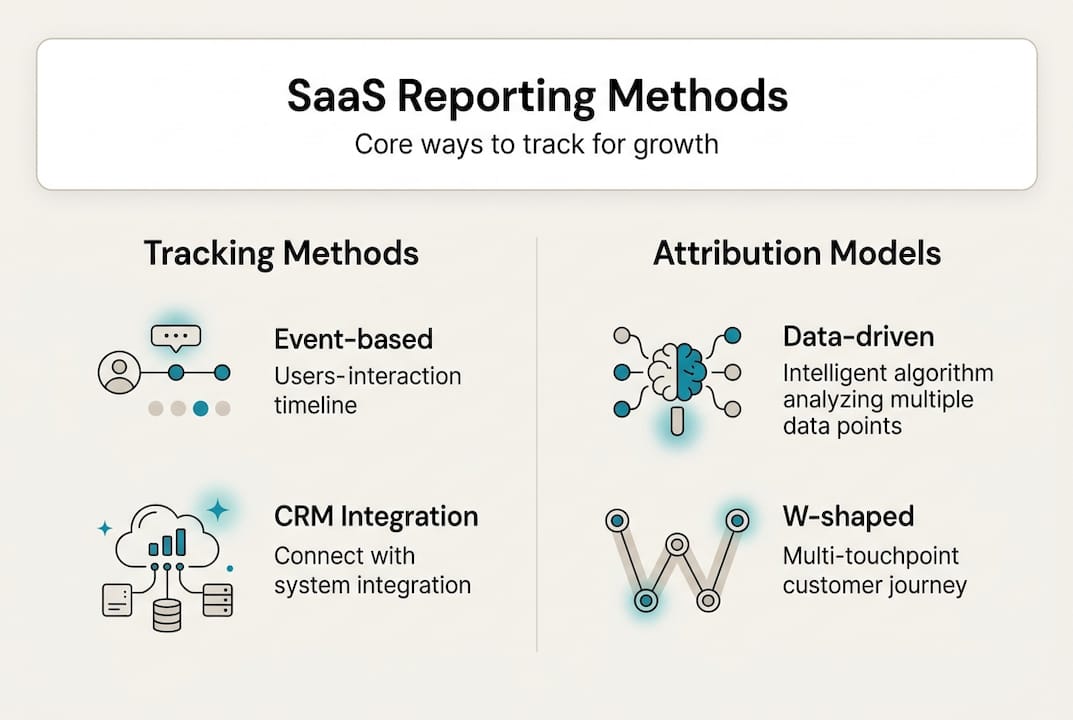
Event-based tracking is the foundation. GA4 operates on an event model, meaning every meaningful user action, from a trial sign-up to a pricing page visit, can be captured as a discrete event. Event-based tracking in GA4 recovers 20 to 40% of lost events compared to session-based models, and multi-touch attribution reveals 65% more channel influence than last-click alone. That is not a marginal improvement. That is a fundamentally different picture of what is driving growth.

CRM integration closes the revenue loop. Connecting GA4 to HubSpot or Salesforce means you can trace a lead from first touch through to closed deal. GA4 and HubSpot reporting setups allow you to see which campaigns generate pipeline, not just traffic. This is the difference between marketing that looks productive and marketing that provably is.
Multi-touch attribution modelling adds strategic depth. Data-driven, time-decay, and W-shaped models each serve different analytical purposes. Running them in parallel, rather than committing to one, gives you a more complete view of channel contribution across the SaaS customer journey data strategies.
| Method | Tracking fidelity | Integration ease | Revenue alignment |
|---|---|---|---|
| GA4 event-based | High | Moderate | Strong |
| Server-side tracking | Very high | Complex | Very strong |
| CRM closed-loop | High | Moderate | Excellent |
| Last-click attribution | Low | Easy | Weak |
| Multi-touch attribution | Very high | Complex | Excellent |
Pro Tip: Run at least two attribution models simultaneously. Data-driven and W-shaped together will surface discrepancies that reveal where your reporting has been misleading you. Align this with your optimised marketing workflow for maximum efficiency.
Essential metrics to track in SaaS marketing reporting
With processes in place, it is time to pinpoint which metrics truly matter for board reporting and everyday optimisation.
Not all metrics are created equal. The ones that matter are the ones tied directly to revenue outcomes and funnel health. B2B SaaS marketing benchmarks provide clear targets: paid MQL to SQL conversion sits at around 30%, while organic achieves 51%. Elite CAC payback is under 80 days. LTV:CAC should exceed 3:1. Net revenue retention (NRR) above 120% signals strong expansion revenue. The Rule of 40, where growth rate plus profit margin exceeds 40%, is a key board-level health indicator.
These are not aspirational figures. They are the benchmarks that 2026 SaaS funnel data shows high-performing teams consistently hitting.
| Metric | Elite benchmark | Why it matters |
|---|---|---|
| MQL to SQL (paid) | 30% | Measures lead quality from paid channels |
| MQL to SQL (organic) | 51% | Signals content and SEO effectiveness |
| CAC payback period | Under 80 days | Indicates capital efficiency |
| LTV:CAC ratio | Above 3:1 | Confirms sustainable unit economics |
| Net revenue retention | Above 120% | Shows expansion beyond churn |
| Rule of 40 | Above 40% | Board-level growth and profitability signal |
Here is what to track at each funnel stage:
- Top of funnel: Organic sessions, paid impressions, cost per click by channel
- Mid funnel: MQL volume, MQL to SQL rate, trial sign-up rate
- Bottom of funnel: Trial to paid conversion, CAC by channel, sales cycle length
- Retention: NRR, churn rate, expansion MRR
For practical examples of how these metrics translate into real outcomes, the SaaS conversions guide and real SaaS marketing results offer grounded case references. Building customer trust in SaaS marketing also plays a measurable role in improving NRR over time.
Step by step: Setting up your SaaS marketing analytics reporting system
Now you know what to track, here is a step-by-step setup so your system delivers reliable insights every week.
- Configure GA4 event-based tracking. Define your key events: trial starts, demo requests, pricing page views, and plan upgrades. Use Google Tag Manager to deploy custom events without developer dependency where possible.
- Connect GA4 to your CRM. Whether you use HubSpot or Salesforce, establish a closed-loop integration so that lead source data flows through to deal stage and closed revenue. This is the single most impactful step for revenue alignment.
- Select and run attribution models in parallel. Set up data-driven attribution as your primary model in GA4, and run W-shaped or time-decay models in your CRM or a dedicated attribution tool for comparison.
- Build tiered dashboards. Executive dashboards should surface ARR, CAC, and LTV:CAC. Operational dashboards should show funnel velocity and channel performance. Dashboard templates in tools like Looker Studio, Amplitude, Databox, or HubSpot integrate GA4 and ChartMogul for MRR and sales close rates in a single view.
- Automate anomaly alerts. Set threshold-based alerts for conversion rate drops, churn spikes, and CAC increases. This keeps your team responsive without requiring manual monitoring. HubSpot analytics advice covers alert configuration in detail.
Pro Tip: Do not build one dashboard for everyone. Separate your executive view from your operational view. Executives need ARR and CAC. Your growth team needs funnel velocity and channel-level data. Mixing them creates noise for both audiences. Pair this with B2B SaaS lead generation strategies to ensure your funnel inputs are as strong as your reporting outputs.
Troubleshooting and avoiding common SaaS analytics pitfalls
Even strong reporting systems have gaps. Here is how to avoid the most expensive mistakes in SaaS analytics.
Data silos remain the most common problem. When your ad platform, GA4, and CRM each report different numbers for the same campaign, trust in the data collapses. Server-side tracking and first-party data strategies reduce discrepancies caused by browser restrictions and ad blockers. HubSpot and GA4 differences in identity resolution are a frequent source of mismatched figures.
The dark funnel is a real challenge. 65% of B2B buyer journeys occur in channels that standard analytics cannot capture, including private Slack communities, word-of-mouth referrals, and direct searches. GA4 captures behaviour. Your CRM captures revenue truth. Neither captures everything. Supplement with pipeline source surveys and self-reported attribution at sign-up.
Here are the pitfalls to actively avoid:
- Reporting on sessions and clicks without connecting them to pipeline
- Using a single attribution model and treating it as definitive
- Building dashboards so complex that nobody uses them
- Ignoring qualitative signals like sales call feedback and churn interviews
- Delaying insight sharing until monthly reviews, when weekly action is possible
“Your analytics system is only as valuable as the decisions it enables. If your team is not acting on the data, the problem is not the data.”
For SaaS brands investing in content marketing and analytics, ensuring content performance is tied to pipeline metrics rather than traffic alone is a critical discipline.
Verifying and acting on your SaaS marketing analytics
Once your analytics are in place and errors avoided, here is how to get repeatable results and drive action.
- Run weekly anomaly checks. Review your key funnel metrics every Monday. Flag any metric that has moved more than 10% week on week and investigate before the next reporting cycle.
- Conduct monthly funnel walk-throughs. Trace a cohort of leads from first touch to closed deal. Identify where drop-off is highest and test one change per cycle.
- Share insights cross-functionally. Your analytics are most valuable when sales, ops, and product teams act on them. Build a weekly insight summary that goes beyond marketing. Automated reviews weekly reduce reporting time by 60%, freeing your team to focus on action rather than assembly.
- Iterate on attribution and segmentation. Every quarter, revisit your attribution model assumptions. Test new audience segments. Adjust spend based on what the data shows, not what you assumed six months ago.
Pro Tip: Pair your analytics reviews with a standing agenda item in your leadership meeting. When data has a dedicated slot, it gets acted on. When it is buried in a report, it gets ignored. Align this with your digital marketing workflow optimisation to build a culture of data-led decision-making. For broader context on SaaS reporting best practices, financial and marketing reporting should be reviewed in tandem.
Advance your SaaS marketing reporting with expert support
Building a reporting system that genuinely connects marketing activity to revenue is not a one-time project. It requires ongoing calibration, model refinement, and the discipline to act on what the data reveals. At Media House, we work with SaaS leaders who are done with fragmented dashboards and ready for reporting that drives real decisions. Our advanced SaaS marketing tips and SaaS conversions strategy resources are built for teams that want precision, not guesswork. If you are ready to build or audit your analytics reporting system, get in touch with Media House and let us show you what SaaS-grade reporting looks like in practice.
Frequently asked questions
What are the key analytics tools for SaaS marketing reporting?
GA4, HubSpot, Salesforce, Amplitude, and Looker Studio are the core tools for end-to-end SaaS marketing analytics, covering behaviour tracking, CRM integration, and dashboard visualisation.
Which SaaS marketing metrics matter most for reporting?
Focus on funnel conversion rates, CAC payback, LTV:CAC, NRR, and the Rule of 40. These benchmarks give you actionable signals rather than surface-level performance indicators.
How do you connect marketing analytics to revenue outcomes?
Integrate GA4 and your CRM for closed-loop reporting, then run multi-touch attribution models to align specific channels and campaigns with pipeline and closed deals.
What is a common mistake in SaaS marketing analytics reporting?
Over-focusing on vanity metrics like sessions instead of revenue-tied KPIs is the most typical pitfall, and it leads to budget decisions based on activity rather than impact.
How often should SaaS marketing analytics be reviewed?
Automate reviews weekly to catch anomalies early and maintain reporting accuracy. Monthly deep-dives complement weekly checks for strategic planning.