
TL;DR:
- Effective SaaS ABM requires clear strategy, aligned teams, and strong data foundations.
- Different ABM models suit various target account sizes and resource levels.
- Successful ABM emphasizes depth over volume, especially for luxury and mission-driven brands.
Account-based marketing promises to transform how SaaS businesses win high-value clients. But for many leadership teams, the reality falls short of the pitch. Programmes stall, technology goes underused, and pipelines barely budge. The truth is that ABM can be overhyped when execution is shallow and strategy is absent. This guide cuts through the noise. Whether you lead a luxury SaaS platform or a mission-driven scale-up, we break down exactly what ABM is, how to build it properly, and where most teams go wrong before they even begin.
Table of Contents
- What is account-based marketing in SaaS?
- Core pillars of a SaaS ABM strategy
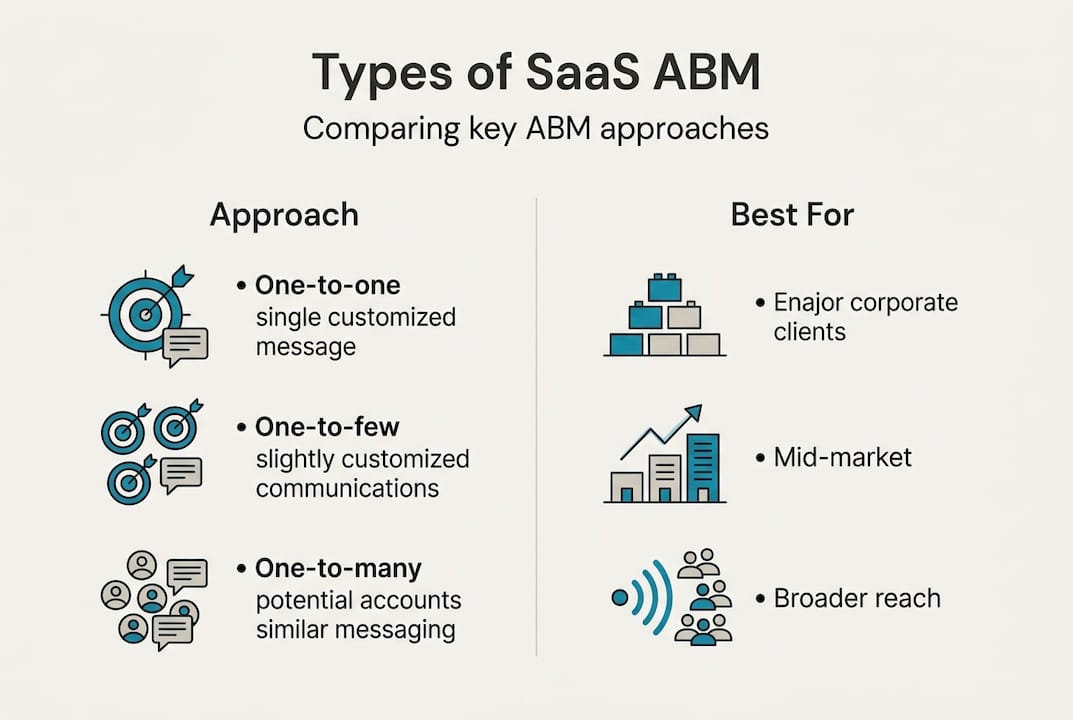
- Comparing ABM types: one-to-one, one-to-few, one-to-many
- Success stories and common pitfalls in SaaS ABM
- What most SaaS ABM advice gets wrong
- Accelerate your SaaS growth with expert partners
- Frequently asked questions
Key Takeaways
| Point | Details |
|---|---|
| ABM is complex, not instant | Success with ABM for SaaS requires more than technology—it demands strategic alignment and robust data discipline. |
| Choose the right ABM type | Match your ABM model to deal size and team capability for optimal impact. |
| Learn from field execution | Launching small, measuring continuously, and adapting yields greater gains than over-investing in unproven tech. |
| Luxury and mission fit | ABM offers exceptional value for SaaS in luxury or mission-driven markets when campaigns are genuinely bespoke. |
What is account-based marketing in SaaS?
Account-based marketing (ABM) is a go-to-market strategy where your sales and marketing teams treat individual target accounts as markets of one. Instead of broadcasting to a wide audience and hoping the right people respond, you identify specific companies, research their priorities, and build campaigns tailored entirely to them.
For SaaS businesses, this is a significant shift. Traditional SaaS marketing often relies on inbound funnels, paid acquisition, and content scaled for volume. ABM inverts this logic. You start with the account and work backwards to the message, the channel, and the timing.
“ABM represents a fundamental realignment of how sales and marketing operate together. It demands shared goals, shared data, and shared accountability.”
This approach works particularly well in specific scenarios:
- High annual contract value (ACV) deals where a single account can justify significant investment
- Niche verticals such as luxury hospitality SaaS, legal tech, or mission-driven platforms with a defined buyer profile
- Complex buying committees involving multiple stakeholders across IT, finance, and leadership
- Expansion plays where you want to grow existing accounts rather than solely acquire new ones
However, ABM can be overhyped for early-stage SaaS organisations that lack product-market fit, clean data, or sales and marketing alignment. Buying an ABM platform before solving these foundational issues is a costly mistake. The technology amplifies what already exists, good or bad.
Before committing to ABM, you need three things in place: a clear ideal customer profile (ICP), reliable intent and first-party data, and genuine leadership alignment between your sales and marketing functions. Without all three, you are running campaigns into the dark.
Understanding where SaaS marketing strategies differ from ABM is essential context. If you are still building organic authority and inbound pipelines, SaaS inbound marketing may be the right foundation before layering in ABM.
Core pillars of a SaaS ABM strategy
Building an effective ABM programme is not about buying the most sophisticated platform. It is about disciplined execution across five interconnected pillars. Successful ABM demands change management and robust data, not just technology investment.
-
Define and prioritise target accounts. Use your ICP to build a tiered account list. Tier one accounts receive the most personalised attention and resource. Tier two and three receive scaled versions. Fewer, better-chosen accounts outperform long, poorly-researched lists every time.
-
Align sales, marketing, and customer success with shared KPIs. ABM fails when teams measure different things. Pipeline influenced, account engagement scores, and expansion revenue are metrics everyone should own together.
-
Integrate intent data and first-party signals. Tools that surface buying intent, such as page visits, content downloads, or product usage patterns, allow you to time outreach precisely. But data quality matters more than data volume. Review your SaaS marketing analytics before investing in additional data layers.
-
Deliver deeply personalised content and triggers. Personalisation goes beyond using a contact’s first name. It means speaking directly to the strategic challenges of a specific account, their sector language, their competitive pressures, and their buying stage. Your data-driven marketing plan should map content assets to each stage of the account journey.
-
Monitor, measure, and iterate continuously. ABM is not a campaign. It is an ongoing programme. Weekly reviews of account engagement, quarterly ICP reassessments, and rigorous attribution will separate programmes that grow from those that plateau. Use your SaaS conversions guide to benchmark what good looks like at each stage.
Pro Tip: Avoid random acts of marketing by mapping every single touchpoint to a specific buyer journey stage and a measurable outcome. If you cannot explain why a tactic exists within the account plan, remove it.
Skipping change management is the single most common reason ABM programmes underdeliver. Leadership must sponsor the shift, teams must be trained on new workflows, and incentive structures must reward account-level outcomes rather than individual lead counts.
Comparing ABM types: one-to-one, one-to-few, one-to-many
Not all ABM programmes look the same. There are three deployment models, and choosing the right one depends on your team size, average contract value, and how narrowly you can define your target sectors.
| ABM type | Effort level | Cost | Best suited for |
|---|---|---|---|
| One-to-one | Very high | High | Enterprise deals, luxury SaaS, single-account bets |
| One-to-few | Medium to high | Medium | Vertical plays, mission-driven SaaS, cluster targeting |
| One-to-many | Lower | Lower per account | Scaling efficiently, pipeline acceleration |
One-to-one ABM is the most intensive. Every element of the campaign is built for a single named account. This works for high-ACV SaaS organisations pursuing a handful of transformative deals. Think bespoke landing pages, personalised video outreach, and account-specific event invitations.

One-to-few ABM groups accounts with shared characteristics, typically five to fifteen per cluster. A luxury hospitality SaaS targeting boutique hotel groups in Europe, for instance, would build one campaign architecture and personalise elements for each cluster. It balances depth with efficiency.
One-to-many ABM uses automation and segmentation to deliver relevant experiences at scale. It sacrifices individual personalisation but gains reach. For early pipeline building or supporting mid-market growth, this model has merit.
The risks to watch in every model:
- Over-automating one-to-one programmes strips the human element that makes them effective
- Ignoring buying committees in favour of a single champion contact is a common failure point
- Scaling too fast to one-to-many before mastering one-to-one creates thin, unconvincing campaigns
For a real-world reference point on how focused execution translates to revenue growth, the SaaS ABM case study we analysed shows what happens when precision replaces volume.
Success stories and common pitfalls in SaaS ABM
The gap between ABM programmes that generate serious pipeline and those that generate impressive-looking dashboards is wider than most leaders expect. Shallow execution and poor alignment are the root causes in the vast majority of failed programmes.
Here is what separates the two:
| Signal | Success | Pitfall |
|---|---|---|
| Account selection | Tight ICP, data-validated | Large lists, low intent data |
| Team alignment | Shared revenue KPIs | Siloed metrics by team |
| Content | Deeply personalised, account-relevant | Generic assets repurposed |
| Measurement | Pipeline, ACV, expansion | Vanity metrics: clicks, impressions |
| Technology | Supports strategy | Drives strategy (tech trap) |
The SaaS teams that win with ABM share several characteristics. They start with a small, high-confidence account list. They build tight feedback loops between sales and marketing. And they resist the temptation to scale before the model is proven.
The teams that lose tend to do the opposite. They invest in platforms before fixing their data. They measure activity rather than outcomes. They celebrate engagement metrics while pipeline stagnates.
Mission-driven and luxury SaaS brands have a natural advantage here. Their value propositions are inherently differentiated, which makes personalisation more authentic and buying committee conversations more meaningful. SaaS founders who lean into their mission as a strategic asset tend to build stronger account relationships than those who lead purely on features.
For revenue leaders running ABM alongside other growth channels, the key is avoiding platform overload. Two or three well-integrated tools will always outperform a disconnected stack of twelve. Start lean, prove the model, then invest further. ROI-focused SaaS marketing depends on clarity of attribution, not complexity of tooling.
Pro Tip: Start with five to ten tier-one accounts. Run your ABM model rigorously for one full quarter. Measure account engagement, pipeline created, and sales cycle length. Only then decide whether to expand the programme or refine the targeting.
What most SaaS ABM advice gets wrong
Most ABM guidance focuses on technology selection and campaign mechanics. It rarely addresses the harder truth: ABM is a cultural shift, not a software purchase.
We see this pattern repeatedly. Leadership approves an ABM platform, assigns it to marketing, and expects results within a quarter. Sales continues working its own list. Data hygiene remains unaddressed. The programme produces activity, not revenue, and the verdict is that ABM does not work.
The problem was never ABM. It was the assumption that technology alone drives transformation. Without disciplined change, clean data foundations, and genuine cross-functional alignment, even the best intent data becomes noise.
For luxury and mission-driven SaaS brands, the answer is not to copy the high-velocity playbooks built for commodity software. Your buyers value relationships, relevance, and shared values. Slow-burn account relationships built on authentic engagement outperform automated sequences every time. Fewer accounts, pursued with greater depth, will consistently outperform large lists chased with thin personalisation.
Pair your ABM programme with reliable inbound marketing to ensure your brand earns authority between direct account touchpoints. That combination is where durable SaaS growth actually lives.
Accelerate your SaaS growth with expert partners
If this guide has clarified where your current ABM approach needs strengthening, the next step is straightforward. At Media House Agency, we work with SaaS founders and revenue leaders who want precision growth without the overhead of a bloated agency. We bring together strategic positioning, cinematic storytelling, and hard performance data to build ABM programmes that actually convert. Explore our SaaS growth marketing strategies or speak directly with our team via our specialised SaaS support hub. If you are also rethinking how your brand positions itself for the accounts that matter most, our SaaS branding for 2026 resource is an excellent starting point.
Frequently asked questions
How is ABM different from traditional SaaS marketing?
ABM targets specific high-value accounts with bespoke campaigns, whereas traditional SaaS marketing casts a wider net with standardised messaging designed to attract volume rather than precision.
What size SaaS company benefits most from ABM?
Mid to large SaaS firms with proven product-market fit and high contract values see the strongest returns from ABM, whilst early-stage startups risk wasting budget before the foundations are in place.
Is ABM software worth the investment for SaaS brands?
ABM software is only as effective as the strategy and data supporting it. Without organisational change and disciplined data management, platforms rarely deliver the ROI that vendors promise.
How can ABM help luxury or mission-driven SaaS brands?
ABM’s precision and relationship depth make it particularly well-suited to luxury and mission-driven SaaS brands that serve a select, high-value client base where personalisation and shared values carry significant commercial weight.